
Personal product concept and system blueprint
Portfolio / 03 · Personal life-management platform
Orbit.
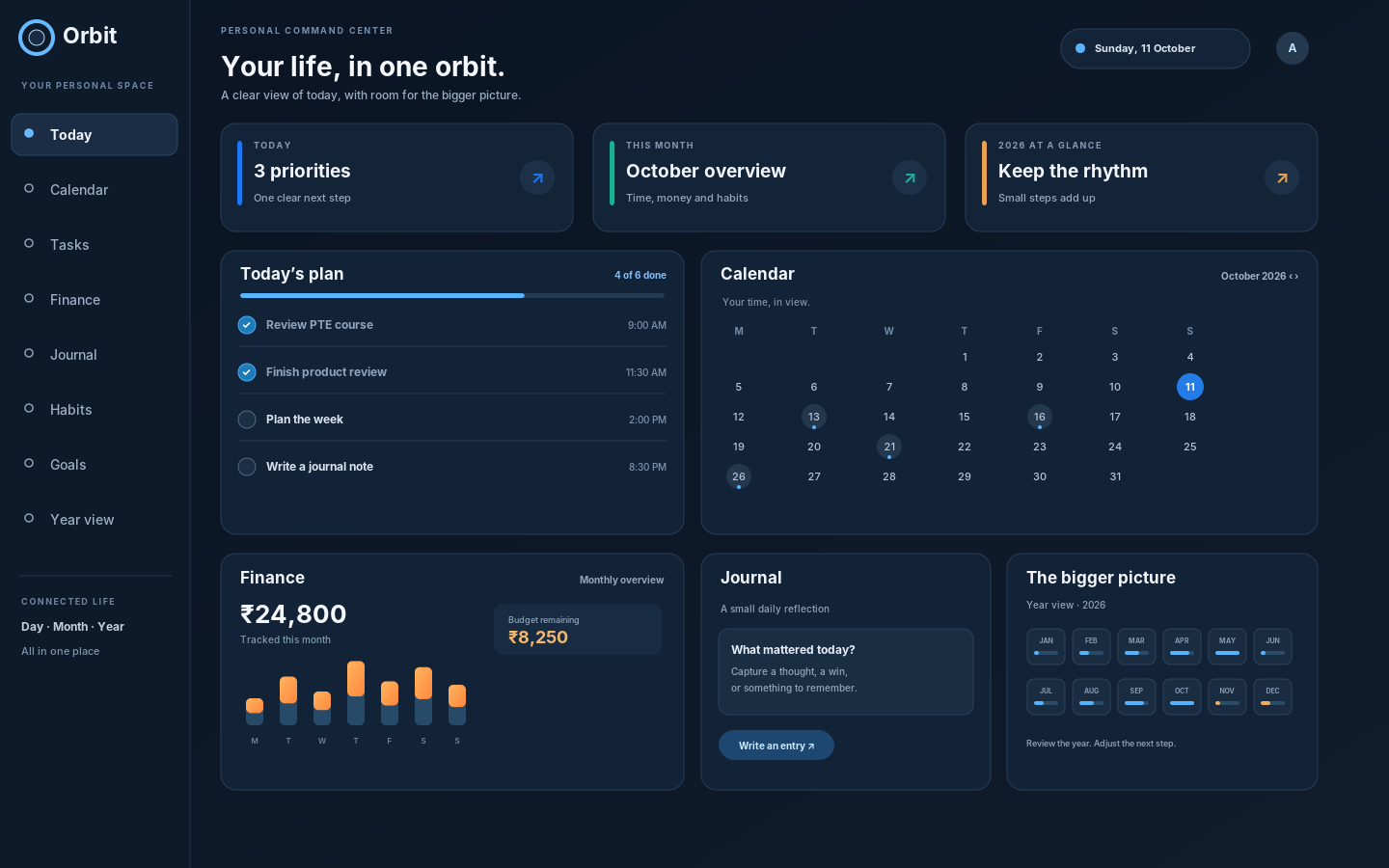
Orbit is a personal operating space for days, months and years—connecting tasks, calendar, finance, goals, habits and journal in a single place that revolves around the person rather than making the person orbit separate apps.
Full product study · Context → Strategy → Experience → Engineering → Validation
01 / The brief
Begin with the problem
the product must solve.
Everyday life is often split across tools: one for money, another for tasks, another for notes, another for appointments and another for reflection. This fragmentation creates repeated entry, disconnected context and a weak relationship between what someone planned, what they did and how the month or year is unfolding.
Disconnected apps create disconnected context
A calendar can show time without explaining priority; a task list can show work without showing the day around it; a finance tool can track transactions without connecting them to goals or reflection. Orbit starts from the person’s need to move between these views without losing the larger picture or repeatedly rebuilding context.
The tool should orbit around the person
Orbit should be flexible enough to reflect how someone actually organises life, while providing a dependable shared structure. It should not force every person into a rigid productivity method. The home view brings today’s commitments and next actions forward, while deeper views let the user plan across weeks, months and years when that horizon is useful.
Bring planning, execution and reflection together
Tasks, events, money, habits, goals and notes should be related when there is a meaningful link, but remain clear as distinct domains. A planned activity may relate to a goal; a recurring expense may affect a monthly plan; a journal note may explain why a habit changed. Connections should reduce manual context switching without creating noisy, automatic relationships that the user cannot understand.
A unified tool must not become an overwhelming dashboard
Putting every metric on one screen would reproduce the fragmentation problem as visual clutter. Orbit needs progressive disclosure: a calm daily overview, focused modules for tasks and finance, and broader calendar or review views. Privacy, data ownership, simple capture and easy correction matter because the product may contain a sensitive picture of the user’s life.
What this study does—and does not—claim
Orbit is a product direction, not a claim that all integrations or tracking features are live. Finance connectivity, reminders, device sync, storage and privacy guarantees must be scoped and tested before they are presented as deployed capabilities.
02 / Product structure
The life-management system, connected by purpose.
The product becomes useful when each area contributes to the whole without turning the home screen into a wall of widgets.
Today and daily rhythm
A clear daily home view brings appointments, priorities, tasks and helpful reminders together. It should distinguish fixed commitments from flexible work, allow quick capture and make it easy to reschedule without making the day feel like a failure.
Calendar and time horizons
Daily, weekly, monthly and yearly views support different decisions. The day view helps execution, month view helps balance and upcoming commitments, and the year view reveals milestones, seasons and patterns. Navigation between horizons should preserve context rather than feel like separate tools.
Tasks and projects
Tasks need status, priority, due dates, recurrence, context and a clear next action. Projects and goals can group tasks, but the system should avoid excessive setup; fast capture, useful filters, dependencies where needed and a trustworthy completed-history are more valuable than decorative complexity.
Finance and recurring obligations
A personal finance area can make income, spending, budgets, recurring bills and goals easier to review. The design must clearly label manually entered, imported and synchronised data, explain update times, prevent accidental duplicates and avoid claiming live banking connectivity until it exists and is verified.
Goals, habits and reflection
Goals provide a longer horizon, habits help make repeated actions visible and the journal gives space to understand the experience behind the numbers. They should connect through user-controlled links and gentle prompts rather than gamification that makes missed days feel punitive.
Personal data and integrations
The user should understand where information lives, how export and deletion work, what syncs across devices and which external services receive data. Integration failures must be visible and recoverable; local notes or private records should not silently become third-party model input.
03 / End-to-end process
How Orbit becomes a coherent personal tool.
The project should validate the daily core loop before layering on every life-management feature.
01
Understand the person’s current system
Map the apps and routines people already use for tasks, money, calendar, diary, habits and long-term planning; identify duplicated entry and missing context.
Deliverable: personal workflow map and friction priorities.
02
Define the time and information model
Specify day/week/month/year views, tasks, events, money records, goals, habits, notes and which relationships are explicit or optional.
Deliverable: domain model and time-horizon rules.
03
Design the daily home view
Prioritise the current day, next action, calendar context and quick capture; create distinct routes to deeper domains without surfacing every detail at once.
Deliverable: home dashboard, navigation map and daily journey.
04
Prototype capture, planning and review
Test adding a task or note quickly, moving a calendar item, checking the month, reviewing an expense and reflecting on a goal using realistic scenarios.
Deliverable: interactive prototype and usability findings.
05
Build the core personal records
Implement tasks, events, notes and preferences with deliberate data ownership, validation, recurrence rules and a clear route to edit or delete records.
Deliverable: reliable core data and interaction layer.
06
Connect finance, goals and habits carefully
Add these domains with clear data sources, units, recurrence, history and user-controlled links. Integrations must state when data is imported, manual or synchronised.
Deliverable: connected modules and provenance rules.
07
Validate privacy, trust and real routines
Test date boundaries, time zones, recurring tasks, duplicate entries, offline edits, data export/deletion, sensitive-field handling and the usefulness of the combined home view.
Deliverable: test evidence and trust checklist.
08
Pilot, tune and expand by evidence
Observe which views save time, where users still switch apps, which reminders help, and what feels too busy. Add automation and integrations only where the pilot shows a concrete need.
Deliverable: pilot insights, priorities and staged roadmap.
04 / Experience principles
Decisions that keep the product coherent.
These principles are the tests used to judge design and implementation choices, especially when a feature competes with clarity, trust or the core job.
Person first, not app first
The home view begins with the user’s context and next decisions; modules support that view instead of competing to become separate destinations.
One entry, understandable connections
Reduce duplicate capture and make relationships visible, editable and explainable rather than silently inferring everything.
Calm by default, deep when needed
Keep today usable at a glance; reveal finance, planning and reflection detail when the user asks for it.
Private and portable
Make data source, sharing, export, deletion and sync behaviour understandable before introducing external integrations.
05 / Quality and validation
How the work is checked before it earns trust.
Validation should be planned against real tasks and credible failure modes. The checks below describe how this product direction should be evaluated; they are not fabricated claims that every test has already passed.
Date and time correctness
Time zones, daylight-saving changes, all-day events, recurring tasks, month lengths and year boundaries behave predictably.
Data consistency
Task, calendar, finance, habit and note edits persist reliably; duplicate sync or retries do not silently create repeated records.
Context clarity
The interface distinguishes scheduled commitments, flexible tasks, estimates, completed records and future intentions.
Financial transparency
Currency, time range, source and update time are visible; calculated totals are traceable and imported data is not mistaken for live sync.
Privacy and control
Users can understand data storage, export/delete paths, device sync and which integrations or AI features can access specific records.
Everyday usability
Quick capture, navigation, text scaling, keyboard/touch use, reminders and review flows work for diverse schedules and levels of organisation.
06 / Evidence and next steps
How Orbit should prove its value
Success should be measured through real routine use and user trust, not by how many modules fit on the dashboard.
Current direction: a unified personal workspace concept around daily planning, tasks, calendar, finance, goals, habits, journaling and longer time horizons. The next step is to prove the daily home view and data model in a bounded prototype before assuming every integration or automation is available.
Signals worth measuring
- People can plan today and find their next action without checking several separate tools.
- Calendar commitments and flexible tasks are easy to distinguish and reschedule.
- Month and year reviews reveal useful context without requiring manual reconstruction of records.
- Finance data is transparent about source, update status and calculation.
- Journal, goals and habits support reflection without punitive streak mechanics or noisy reminders.
- People understand and can control how their personal information is stored, synced, exported and used.
Next milestones
- 01Validate the core day-view and quick-capture journey with realistic routines.
- 02Define the data model and relationships across calendar, tasks, finance, goals and notes.
- 03Prototype month/year reviews and evaluate whether they reduce context switching.
- 04Agree privacy, sync, export and finance-data rules before integrating external services.