
PTE learning product direction
Portfolio / 01 · PTE preparation platform
FLUENTRIX.
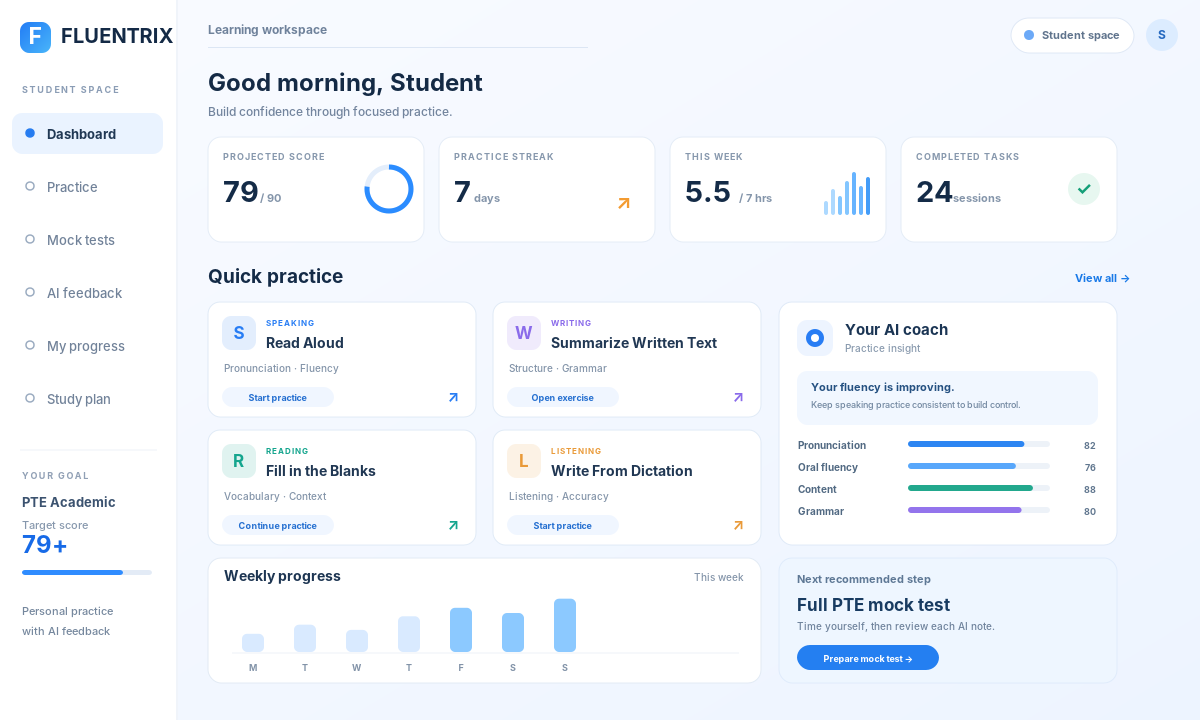
A dedicated PTE preparation environment built around the student’s real loop: understand the task, practise it, receive specific feedback, recognise the pattern behind a mistake and choose the next useful exercise.
Full product study · Context → Strategy → Experience → Engineering → Validation
01 / The brief
Begin with the problem
the product must solve.
Preparation resources can become fragmented across notes, sample questions, score screenshots and generic advice. A student may practise repeatedly without being able to tell which skill is limiting performance, whether a response matched the task and what to do differently next time. The product needs to connect instruction and practice without implying that AI feedback is an official PTE score.
Practice without diagnosis is repetition, not a learning system
Students need more than a large bank of questions. They need the relationship between a task, the response they produced, the criteria that matter and a specific next action. The design starts with that feedback loop and gives practice a clear purpose instead of treating every exercise as an isolated activity.
Support different starting points without overwhelming the student
Some learners are learning task formats for the first time; others know the structure but need targeted improvement, greater consistency or better time management. The experience should let a learner set a target and see a useful next step, while keeping explanations readable and allowing deeper guidance when requested. No single study schedule or skill diagnosis should be imposed on every student.
Bring task practice, review and progress into one flow
The product connects skill areas, task instructions, attempt capture, feedback, examples, revision and progress review. The central unit is a complete practice cycle: prepare, attempt, inspect the feedback, retry or review a related concept, and record what changed. The AI assistant supports this cycle rather than replacing the student’s own reasoning.
Useful guidance must remain clear about its confidence and limits
PTE tasks have different demands and response modes. Feedback should be task-specific and explainable, not a generic paragraph attached to every answer. The interface must separate official task instructions, reference criteria, AI-generated coaching and any estimated indicators so learners do not mistake a suggestion for an official result.
What this study does—and does not—claim
The current direction is a focused PTE course with its own learning assistant. Any automated score or feedback must be clearly identified as guidance or an estimate unless an authoritative scoring source is explicitly available; student data and recordings require deliberate privacy, retention and consent design.
02 / Product structure
The learning system, broken into real product areas.
These are connected parts of the product direction; each should be specified and validated before being described as production-ready.
Exam and task map
Organise the course around the actual PTE task families and the skills each one exercises. Each task view should explain instructions, preparation time, response expectations and common error patterns using reviewed learning content.
Skill-specific practice
Give Speaking, Writing, Reading and Listening appropriate interaction patterns, response capture and review methods. A spoken response needs a different feedback presentation from a reading item or a written essay.
Feedback that teaches
Explain a strength, a priority improvement and a concrete way to retry. Ground feedback in a task-specific rubric or reviewed criteria, show examples where helpful and avoid vague scores that do not tell the learner what to change.
Mock tests and readiness
Provide a focused simulation path with clear instructions, timing, task sequence and a post-test review. Distinguish practice simulations from official exam conditions or certified scoring.
Progress and weak-area diagnosis
Track attempts, review history and skill themes so the student can notice patterns over time. Show evidence and context instead of reducing learning to a single unqualified percentage or opaque readiness number.
Dedicated AI learning assistant
Help explain task instructions, analyse an attempt, suggest practice and answer course questions using approved content. Keep tool permissions narrow, protect recordings and written responses, and make uncertainty and source boundaries visible.
03 / End-to-end process
From student need to a validated learning loop.
The build sequence is designed to test the learning logic early, then extend it task by task.
01
Research learner jobs
Map score goals, time constraints, current study habits, task confusion, feedback expectations and accessibility needs; distinguish evidence from assumptions.
Deliverable: learner needs map and priority learning outcomes.
02
Map task formats and criteria
Document every in-scope task, official instructions, input/output mode, timing, reference material and review criteria from authoritative sources.
Deliverable: task catalogue and content-validation checklist.
03
Design the practice journey
Define onboarding, target setting, skill selection, attempt, feedback, review, retry, progress and return-to-study states.
Deliverable: task flows and student journey prototypes.
04
Build one complete task loop
Implement a representative end-to-end task before expanding across all types; verify that a learner can practise, understand feedback and act on it.
Deliverable: tested vertical slice for a practice task.
05
Develop feedback and AI boundaries
Define structured feedback, evidence links, prompt/context versions, fallback responses, uncertainty display and rules for handling sensitive student content.
Deliverable: feedback rubric and AI behaviour specification.
06
Add progress and mock-test layers
Connect attempt history, weak-skill themes, practice plans and mock-test review without confusing simulated indicators with official scoring.
Deliverable: progress model, reporting views and mock-test flow.
07
Evaluate educational usefulness
Use expert-reviewed examples, edge cases and learner reviews to measure feedback relevance, consistency, task completion and whether advice leads to a useful retry.
Deliverable: evaluation set, issue log and acceptance criteria.
08
Pilot, refine and expand coverage
Pilot a bounded set of task flows, fix confusing guidance, verify accessibility and privacy behaviours, then add task types using the validated design pattern.
Deliverable: phased roadmap and release readiness checklist.
04 / Experience principles
Decisions that keep the product coherent.
These principles are the tests used to judge design and implementation choices, especially when a feature competes with clarity, trust or the core job.
Practice before decoration
The shortest path from choosing a task to completing a meaningful attempt should be clear. Visuals reinforce learning hierarchy; they do not compete with instructions.
Feedback must be actionable
Every coaching message should prioritise a change, explain why and offer a way to retry. A long critique without a next step is not enough.
Separate guidance from authority
Clearly mark AI-generated commentary, estimated signals and reference criteria. Never suggest an official score has been awarded when it has not.
Respect learner privacy
Voice recordings, writing samples, history and target scores require transparent use, appropriate retention and careful access control.
05 / Quality and validation
How the work is checked before it earns trust.
Validation should be planned against real tasks and credible failure modes. The checks below describe how this product direction should be evaluated; they are not fabricated claims that every test has already passed.
Task accuracy
Instructions, preparation and response flows match the agreed current PTE task specification and are checked whenever source material changes.
Feedback consistency
Review examples across different response qualities, accents or writing styles; check that similar evidence receives comparable guidance and known limits are explained.
Student comprehension
Observe whether learners understand feedback, can identify a priority improvement and can start a useful next attempt without facilitator intervention.
Scoring transparency
Any estimated indicator is clearly labelled, calibrated to available evidence and never misrepresented as an official result.
Accessibility and fairness
Test readable instructions, keyboard support, audio controls, response recovery and feedback quality across appropriate learner examples without assuming a single learning style.
Privacy and reliability
Protect recorded and written responses, explain retention, handle upload or transcription failures gracefully and allow the student to recover important work.
06 / Evidence and next steps
How success should be evaluated
No performance results are claimed here. The product should be evaluated against learner outcomes and product reliability once a representative pilot and baseline exist.
Current direction: a dedicated PTE course experience and an associated AI learning assistant. The complete product scope should progress through authoritative task mapping, reviewed learning content, task-level prototypes, feedback evaluation and a bounded pilot; visual concepts alone should not be read as evidence that all listed capabilities are already live.
Signals worth measuring
- Students can complete a practice task and understand its instructions without unnecessary friction.
- Feedback identifies a concrete, task-relevant improvement and explains how to act on it.
- Learners return to a suggested practice step and can see the context for that recommendation.
- Progress views help students recognise recurring weak areas rather than only display activity totals.
- The AI assistant consistently separates grounded course information from uncertainty or unsupported requests.
- Audio, written responses and account information are handled according to clear privacy and retention rules.
Next milestones
- 01Validate the in-scope PTE task catalogue and source content.
- 02Prototype and assess complete end-to-end practice loops for representative tasks.
- 03Define and test feedback rubrics, scoring disclaimers and AI assistant boundaries.
- 04Pilot with learners, review evidence and expand task coverage in measured phases.